
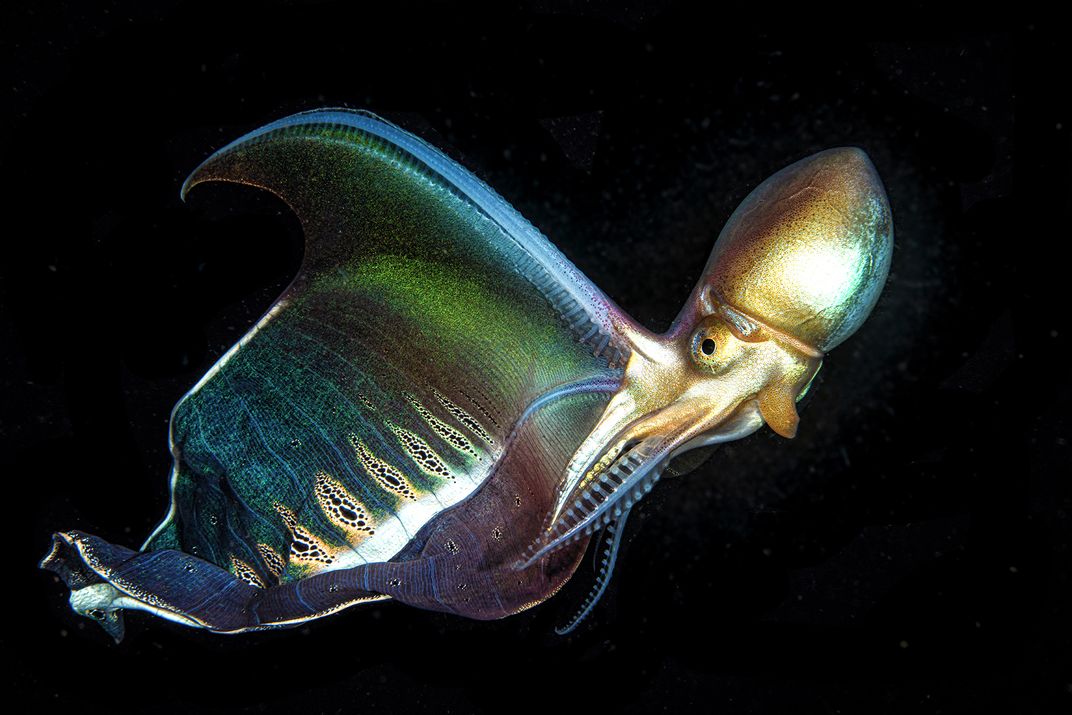
Tremoctopus sp. To verify the exact species, one would need to examine the pattern present on the large interbrachial membrane, which gives this interesting genus the nickname "covered octopus." It undoubtedly possesses some truly unique and interesting morphological and ethological peculiarities, including the ability to wield stinging tentacles to occasionally target predators, but probably also for its own prey. It also possesses aqueous pores (hence the genus name Tremoctopus, meaning "holey octopus") located on its body, the purpose of which is still a matter of debate (I hypothesize they may help the animal move more easily under strong underwater pressures). Furthermore, transverse lines are visible on the interbrachial membrane, or predetermined autotomy planes. This allows the octopus, in case of extreme danger, to voluntarily detach squares of membrane which become a target for the predator along the water column. I also remember that this species presents the highest degree of sexual dimorphism in the world, with the male dwarf-shaped (as is typical in all species of holopelagic octopuses)
| Date Taken: | 06.2024 |
| Date Uploaded: | 11.2025 |
| Photo Location: | Anilao, Philippines |
| Camera: | NIKON D850 |
| Copyright: | © Giacomo Marchione |