
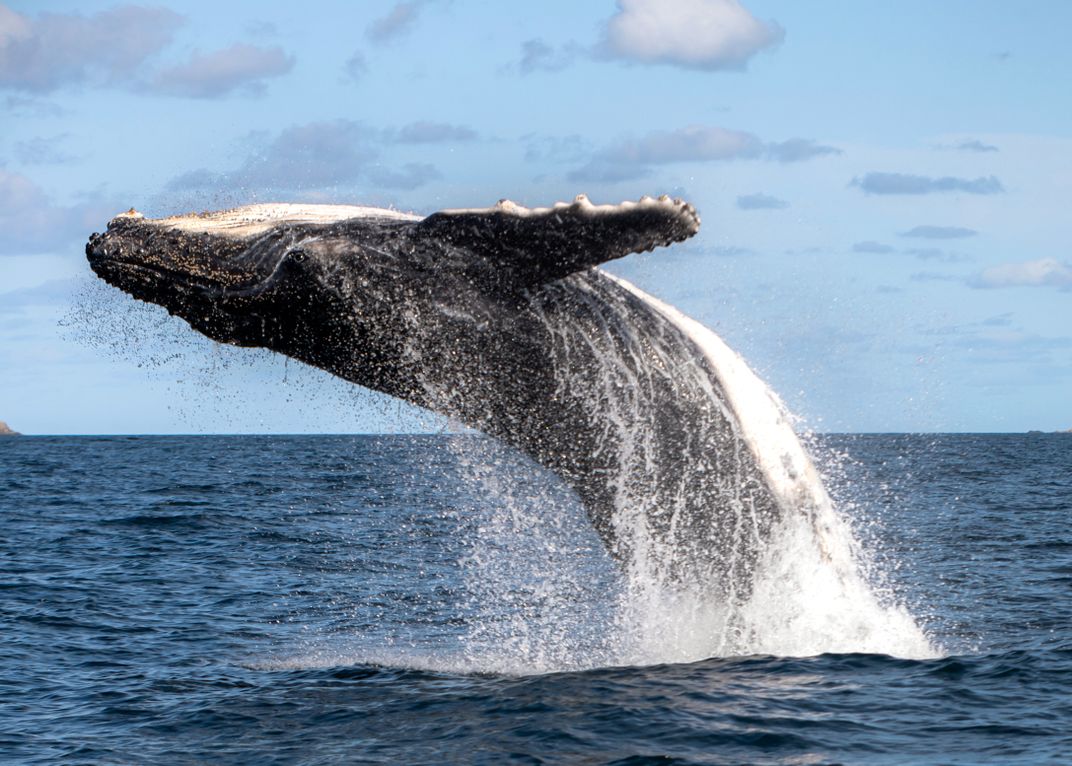
Humpback Whale Breaching Each year, between May and November, the southern hemisphere Humpback whales migrate from their antarctic summer feeding grounds north to their breeding and birthing grounds in the tropics. Separate populations migrate up the east and west coasts of Africa, south America, Australia and towards the south Pacific islands. The population that migrates up the east coast of Australia is estimated to be up to 17 000 individuals. Once in the tropics male and female Humpback whales mate and pregnant females give birth to calves. The whales then migrate south again to spend the antarctic summer feeding in preparation for their northern migration the following year. Humpback whales are believed to use landmark to assist with navigation. This trait is what ties them so close to the coast. In the past this behavior made them vulnerable to commercial whaling operations and a dramatic decrease in the population has been witnessed. Since commercial whaling ceased in the 1970s, the population has recovered significantly but is considerably short of what it was prior to commercial whaling (approximately 28 000). The fact that Humpback whales travel in close proximity to the shore line and that Cape Byron is Australia’s most easterly point makes this region one of Australia’s premier whale watching destinations.
| Date Taken: | 10.2020 |
| Date Uploaded: | 10.2020 |
| Photo Location: | Byron Bay, Australia |
| Camera: | Canon EOS RP |
| Copyright: | © Hadriel Torres |