
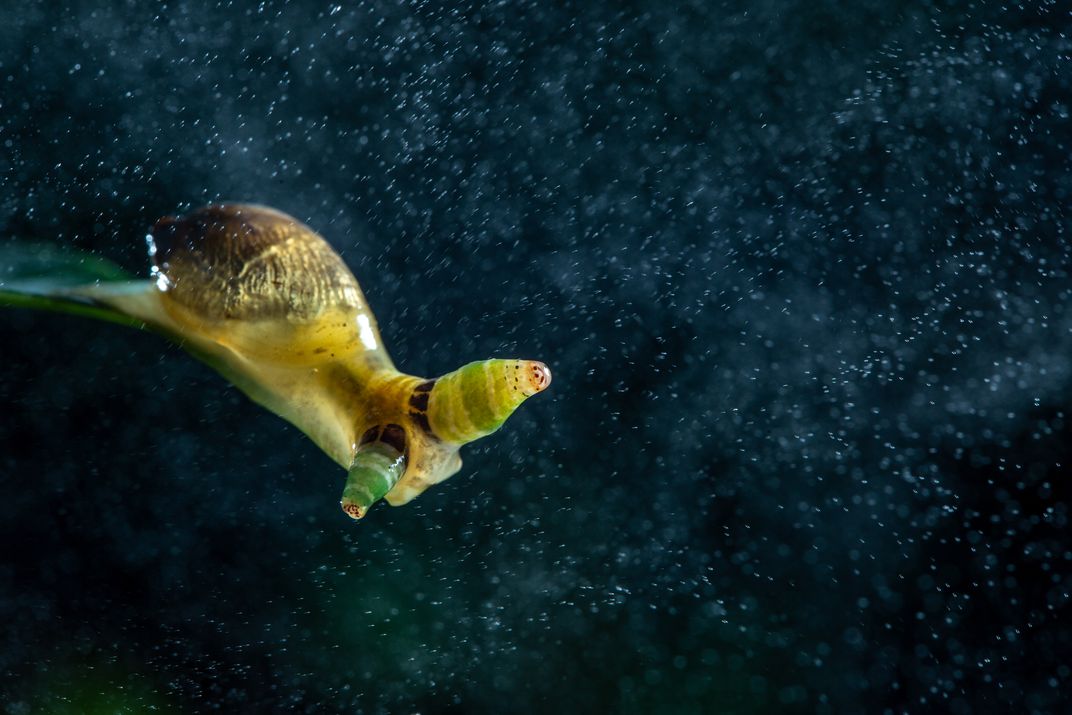
A Snail of Succinea species is infected by a parasite belonging to Leucochloridium species. Leucochloridium is a species of trematode whose life cycle involves the alternate parasitic invasion of certain species of snail and bird. While there is no external evidence of the worm's existence within the bird host, the invasion of the snail host involves the grotesque swelling of one or both of the snail's eye stalks. This invasion does not cause the snail's death. The swollen, pulsating eye stalk resembles a maggot. This modification attracts the parasite's definitive hosts, birds: the bird rips off the eye stalk and eats it, thus becoming infected with the sexually mature parasites. Later on the parasite's eggs are dropped with the bird's feces. The feces which lands on leaves below is again consumed by some of the snails thus continuing the cycle. I found the parasite to be active when the climate was cooler and moist. In times of heavy rain, the parasite got more active and started pulsating rapidly from the snail’s eyes. I took this image with the help of 2 flashes, with one flash backlighting the raindrops after they fell on the leaves the snail was sitting on thus creating the bokeh and watery effect. 2nd Flash was used to light up the Snail with a Softbox.
| Date Taken: | 07.2021 |
| Date Uploaded: | 11.2021 |
| Photo Location: | Neral, India |
| Camera: | Canon EOS 5D Mark III |
| Copyright: | © Prathamesh Ghadekar |