
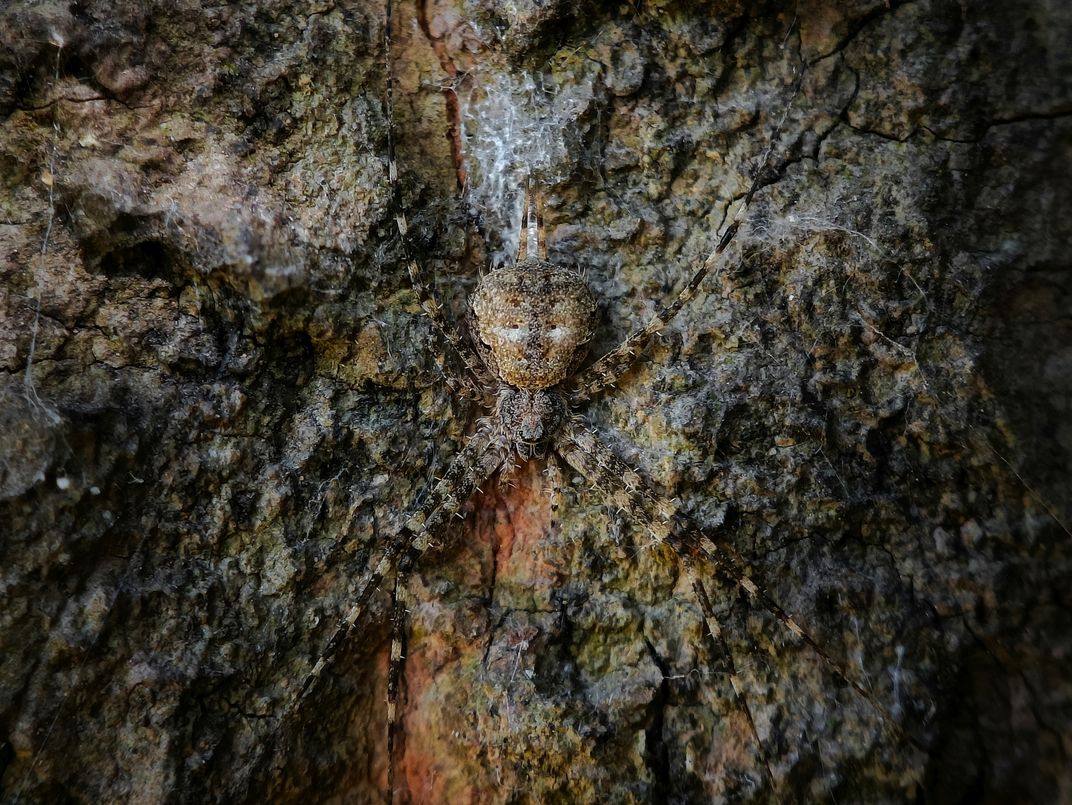
Perfectly camouflaged against the tree trunk, the two-tailed spider (Hersilia savignyi) is a remarkable example of cryptic adaptation. Belonging to the family Hersiliidae, this arboreal species is widely distributed across dry deciduous and tropical forests of Asia where it spends much of its life on tree bark. Its elongated bark-like body coloration and extended posterior spinnerets , which resemble an additional pair of tails allow it to merge seamlessly with rugged surfaces. By pressing its dorsoventrally flattened body against bark grooves, the spider achieves near invisibility, reducing detection by both visual predators and unsuspecting prey. Unlike web-weaving spiders, H. savignyi relies on sit-and-wait predation. It anchors silken threads radiating from its resting position and when prey approaches it employs rapid circular movements to entangle the insect before delivering a venomous bite. This hunting strategy coupled with morphological mimicry reflects an evolutionary specialization that enhances both predatory efficiency and predator avoidance. Such dual functionality underscores the adaptive value of camouflage, highlighting how natural selection shapes morphology and behaviour in response to ecological pressures.
| Date Taken: | 12.2024 |
| Date Uploaded: | 12.2025 |
| Photo Location: | Bhadrak, Odisha, India, India |
| Copyright: | © Sritam Kumar Sethy |