
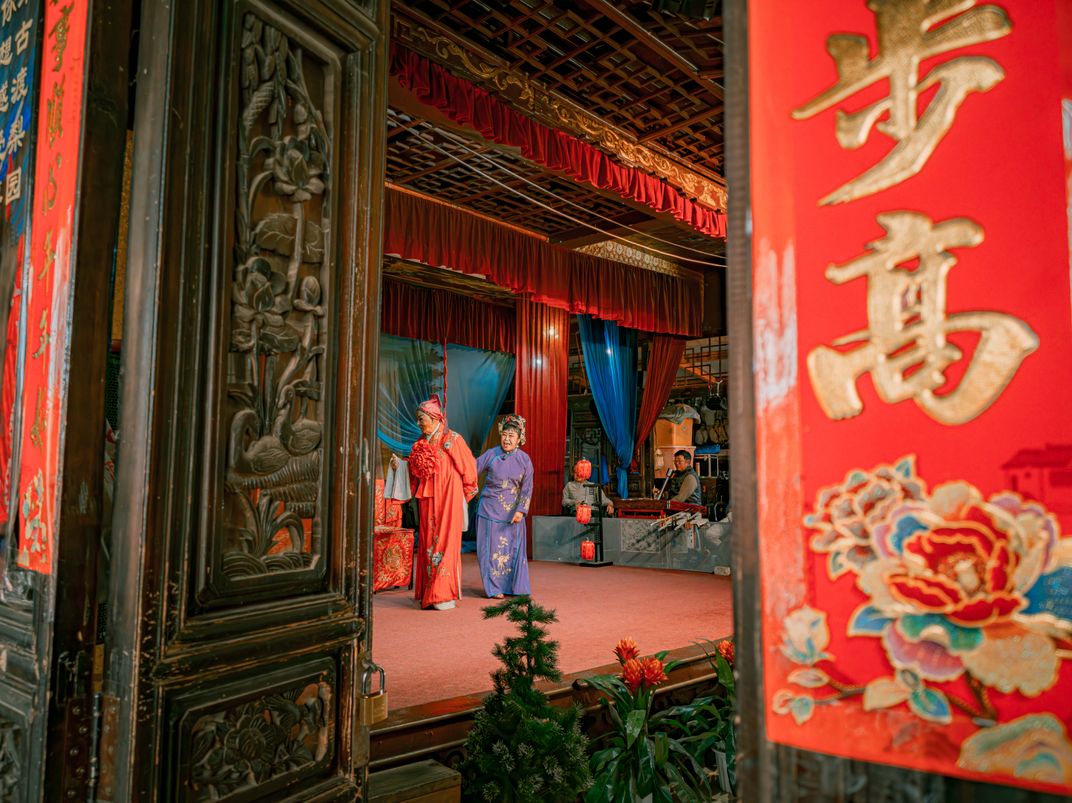
Yunnan opera is an important branch of traditional Chinese opera, and one that reflects the colourful Yunnan ethnic multiculturalism of southwest China. However, in today’s fast-developing society, this regional drama is in decline, and is gradually being forgotten by most people. There are only a few folk troupes remaining that represent Yunnan Quyi culture, and the average age of their members and audiences is increasing. This particular theatre is located along a small alley and charges just seven yuan for a ticket.My hometown is Kunming, Yunnan, and Dianju, a traditional Chinese opera culture, belongs to my hometown of Yunnan.Although Dianju is an intangible cultural heritage, it does not have the same prestigious reputation as Peking Opera, Yue Opera, Huangmei Opera, Pingju Opera, and Yu Opera. In front of them, Dianju is an "ordinary person". Although local governments have established institutions such as Dianju theaters to promote and retain this culture, these institutions have their own official tasks to do. If the public wants to access it, they also need a certain "ability", and folk opera troupes survive in the cracks, The place I filmed is in a small alley in Guandu Ancient Town, Kunming. There are hardly any young viewers inside, and there are only a few remaining theater troupes. The venue is indeed so dim and rich in time, and the audience seats are filled with smoke and smoke. Except for every member of the cast in the venue who is not "generating power for love", the helplessness for the future of the theater company is not on your face. If you are a young person, you will find their joy when entering this theater, because you seem to be the person who discovered the treasure. Dianju has been dormant for so many years, and it seems like you have finally discovered it. It is not only the government that can truly protect this culture, but ourselves. This culture used to be like a huge rock on the shore, shining and captivating. At that time, people couldn't help but marvel at its beauty. However, after a century of continuous development, it has been polished into a small grain of shiny sand. Now, if we don't calm down and discover it, look at it, and hold it in our hands, Perhaps it will be swept away by a wave and disappear into the vast history. What I want to do is to let everyone see it when they get to know it, not in history textbooks or museums, but to be able to personally enjoy listening and watching its rich appearance accumulated from the river of time. Many people have stumbled and stumbled through the history of thorns and thorns, and they have come to our present eyes. They used to sound brightly with gongs and drums, but the Qing Dynasty did not change them, the Xinhai Revolution did not dissipate them, and New China did not forget them. We should understand it, cherish it, and cherish it.
| Date Taken: | 10.2022 |
| Date Uploaded: | 11.2023 |
| Photo Location: | Kunming, China |
| Camera: | VOG-AL10 |
| Copyright: | © Long Jing |